
JRAD Magnetic Flight Suit

Key Specifications
- Total Suit Weight: 50–70 lbs
- Pilot Weight Reference: 243 lbs
- Propulsion Array: 25 coils (5×5 configuration)
- Power System: Dual AFSG units with turbine flywheels
- Cruise Speed: ≤ 75 mph (recommended for unlimited flying time)
- Altitude Envelope: ≤ 150 ft (recommended)
- Endurance: Near‑indefinite in rotation mode
- Thermal Management: Coil rotation + passive venting
THE ORIGIN OF WEARABLE PROPULSION -
How JRAD Flight Systems & Technology Became the First to Achieve It Through the Laws of Hollow Physics.
There are moments in human history when a technology does not simply advance — it redefines the boundary of what a human body can do. The wheel extended our stride. The engine extended our reach. The rocket extended our horizon. But none of these technologies ever crossed the final threshold:
to make propulsion something you wear.
For centuries, propulsion was external — a machine you rode, a vehicle you entered, a system you controlled from the outside. Humanity accepted this separation as natural, as if mobility itself required distance between the mover and the moved.
JRAD rejected that assumption.
Because JRAD understood something no one else saw:
propulsion is not a machine — it is a field.
And fields can be worn.
This realization did not come from aerospace tradition, nor from mechanical engineering, nor from the lineage of jetpacks and exosuits. It came from a deeper place — the physics of recursion, the geometry of magnetic continuity, the architecture of Hollow Physics.
Hollow Physics revealed that magnetic fields are not merely forces; they are envelopes, structures, continuums capable of supporting, lifting, and sustaining a human body when shaped with precision. It showed that energy does not need to be consumed — it can be recirculated. It showed that propulsion does not need to be external — it can be integrated. It showed that mobility does not need to be engineered around the human form — it can be engineered into it.
From this doctrine emerged the first principle of Wearable Propulsion:
Propulsion becomes possible the moment the human body becomes part of the field.
And so JRAD built the first system that made this principle real.
The JMPS Magnetic Flight Suit was not designed as a vehicle. It was not designed as armor. It was not designed as a machine. It was designed as a continuation of the human form, a wearable magnetic envelope that merges biological motion with field‑based mobility.
Axial‑flux flywheel turbines became the heartbeat.
Regenerative power loops became the circulatory system.
The magnetic propulsion array became the musculature.
The AFSG became the spine — the stabilizing axis of recursive energy.
For the first time in human history, propulsion was not something you stepped into.
It was something you put on.
This is why JRAD stands alone.
Not because it built a suit or engineered a system, but because it created a new category of human mobility — one that did not exist before Hollow Physics made it possible.
Wearable Propulsion is not a feature.
It is not a product.
It is not a concept.
It is a frontier — and JRAD Flight Systems & Technology is the first to cross it.
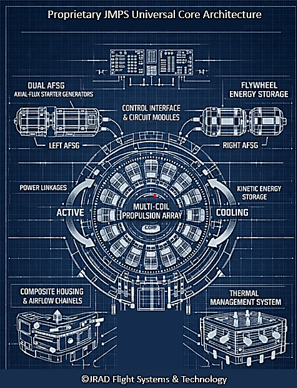
Core Architecture
The JMPS Flight Suit is built around a multi‑coil magnetic propulsion array segmented into coordinated sub‑arrays that cycle through active, standby, and cooling phases. This rotation maintains thermal stability while delivering sustained lift and controlled forward propulsion within recommended operating thresholds (≤ 150 ft altitude, ≤ 50 mph cruise). Dual Axial‑Flux Starter Generators (AFSG) with integrated flywheels provide continuous electrical power with 85–90% energy‑recycling efficiency. The flywheels buffer rapid load changes, stabilize thrust output, and support smooth magnetic field transitions across the propulsion spine. Composite structural housings, internal airflow channels, and distributed heat paths maintain thermal neutrality throughout the system. Together, these components form the JMPS Core Architecture — a compact, high‑density magnetic engine engineered for safe, stable, and repeatable human‑scale flight.
Dual Axial‑Flux Starter Generators (AFSG) with integrated flywheels provide continuous power generation with 85–90% energy recycling efficiency. Thermal neutrality is maintained through composite housing, airflow channels, and coil rotation cycles.
Suit Identity Code (SIC)
Each mobility system is bound to a single authorized pilot through a quantum‑resistant authentication protocol. Activation requires successful identity verification using multi‑layered cryptographic checks designed to withstand emerging quantum‑computing threats. Once authenticated, the system binds the pilot’s identity to all flight operations, telemetry, and safety governance functions.
Applications
The JMPS Flight Suit is designed for personal mobility, rapid response, reconnaissance, and specialized engineering operations. Its modular architecture allows future integration with JRAD’s broader magnetic ecosystem, including drones, habitats, and ground‑based magnetic infrastructure.