
Magnetic Ecosystem
The Magnetic Ecosystem — Where Mobility Becomes Environment
For centuries, mobility has been defined by the surfaces we could touch. Roads shaped our cities. Runways shaped our skies. Shorelines shaped our trade. Every movement humanity engineered was a negotiation with the physical world — a compromise between intention and terrain.
JRAD ends the compromise.
Magnetic propulsion does not rely on ground, water, or atmosphere. It creates its own field environment, a self generated domain where movement is no longer constrained by friction, buoyancy, or lift. Mobility becomes independent of the medium beneath it.
This is the first mobility architecture in human history that is terrain agnostic.
In the Magnetic Ecosystem, mobility is not a vehicle. It is not a machine. It is a continuum — a shared magnetic language that every system speaks:
• Emergency vehicles that glide across land, water, and vertical space with equal ease
• Law enforcement platforms that patrol omnidirectionally without roads or flight paths
• Medical habitats that hover directly above the point of need
• Drones that operate without aerodynamic dependency
• Regenerative power systems that recycle magnetic energy into continuous motion
Mobility becomes coherent — every component operating within the same magnetic field architecture, every movement powered by the same regenerative cycle.
This is not an upgrade to transportation. It is a redefinition of mobility itself.
The Magnetic Ecosystem transforms the planet — and every planet — into compatible space. No terrain is hostile. No distance is inefficient. No environment is off limits.
With JRAD, mobility becomes a living system, not an industrial one. It adapts. It harmonizes. It regenerates.
This is the future of movement. Not faster. Not cleaner. Different.
OPEN YOUR MIND AND YOUR EYES TO A FUTURE OF MOBILITY THAT IS FUEL AND COMBUSTION FREE.
Emergency Services Vehicles

The JRAD Flight Suit is the core of the magnetic ecosystem. It generates its own lift, thrust, and stability through a multi‑field magnetic architecture. Dual axial‑flux turbine flywheels provide continuous power regeneration, enabling silent, emission‑free flight.
Law Enforcement Vehicles

Magnetic Law Enforcement — Command Mobility in Equilibrium Law enforcement has always been bound by terrain — patrol cars confined to roads, helicopters limited by airspace, and officers constrained by distance. JRAD dissolves those boundaries. Through magnetic propulsion, policing becomes a field‑based operation, not a surface‑based pursuit. In the Magnetic Ecosystem, every law enforcement unit operates within the same magnetic continuum — cruisers, command vehicles, drones, and tactical teams all synchronized through shared magnetic fields. The result is omnidirectional mobility, instantaneous coordination, and non‑contact intervention. The magnetic police cruiser represents precision and continuity — a patrol system that glides silently through urban corridors, maintaining field equilibrium without friction or fuel. The magnetic SWAT command vehicle embodies authority and stability — a mobile command post capable of deploying anywhere, unaffected by terrain or obstruction. Above them, magnetic drones extend awareness, forming a unified field network that connects every responder in real time. This is not policing reimagined through technology; it is policing redefined through magnetic architecture. JRAD transforms enforcement from reactive pursuit to proactive stabilization — a doctrine where mobility itself enforces order. In magnetic equilibrium, law enforcement becomes omnipresent yet unobtrusive — a system that protects through coherence, not confrontation.
Medical Habitats

Magnetic Medical Habitats — Healthcare That Moves With the Crisis Traditional medical infrastructure is fixed to geography — hospitals anchored to streets, clinics bound to buildings, and emergency care limited by distance. JRAD breaks that dependency. With magnetic propulsion, medical care becomes mobile architecture, able to position itself precisely where it is needed, independent of terrain, access routes, or environmental conditions. A Magnetic Medical Habitat is not a vehicle and not a building. It is a field‑supported medical environment, a fully functional treatment center suspended in magnetic equilibrium above land. Beneath the habitat, concentric magnetic rings generate lift, stability, and power, allowing the structure to hover with absolute precision — even in areas unreachable by ground transport. This mobility transforms the role of medical response. Instead of transporting patients to care, JRAD brings care directly to the patient. Disaster zones, remote regions, collapsed infrastructure, and high‑risk environments all become accessible medical space. Inside the habitat, power, climate, and life‑support systems are sustained through magnetic regeneration, creating a self‑contained medical ecosystem capable of operating autonomously for extended periods. Outside, the magnetic field envelope provides environmental shielding, stabilizing the habitat against wind, debris, and uneven terrain. This is not a temporary shelter or a mobile clinic. It is a hovering medical institution — a deployable hospital that exists above the limitations of geography. In the Magnetic Ecosystem, healthcare becomes immediate, adaptive, and terrain‑agnostic. JRAD transforms medical response from a logistical challenge into a field‑based certainty.
Magnetic Drones

Magnetic Drones — The Autonomous Field Network of the Magnetic Ecosystem In every mobility system, there is a layer that binds the whole architecture together. For JRAD, that layer is the Magnetic Drone Network — autonomous, terrain‑agnostic, and continuously synchronized through magnetic field continuity. Unlike aerodynamic drones that depend on lift, thrust, and battery‑limited flight, JRAD Magnetic Drones operate on the same magnetic propulsion principles as full‑scale vehicles. They hover in equilibrium, glide without turbulence, and maintain position with millimeter‑level precision — even in environments where traditional drones cannot fly. Powered by Axial Flux Starter Generators (AFSG) paired with regenerative flywheel cycling, these drones achieve indefinite operational endurance within their continuity envelope. They do not land to recharge, do not rely on aerodynamic lift, and do not consume fuel. Their magnetic propulsion system recycles energy through continuous field stabilization, allowing them to remain aloft as persistent nodes in the JRAD mobility network. These drones are not accessories to the ecosystem; they are its sensory and operational backbone. They map magnetic fields, relay positional data, extend situational awareness, and maintain real‑time continuity between emergency vehicles, law enforcement units, medical habitats, and regenerative power systems. Every drone becomes a node in a distributed magnetic intelligence network — a system that perceives, analyzes, and adapts faster than any human‑directed infrastructure. In emergency response, drones scout collapsed structures, guide firetrucks through smoke, and deliver micro‑payloads with perfect accuracy. In law enforcement, they provide non‑intrusive overwatch, stabilize field geometry, and coordinate unit movement without the need for pursuit. In medical operations, they locate survivors, assess environmental conditions, and extend the reach of hovering medical habitats. Because they share the same magnetic propulsion architecture, Magnetic Drones form a persistent aerial presence — a continuous, self‑sustaining field network that never needs to touch the ground. Magnetic Drones are not tools — they are the connective intelligence of the Magnetic Ecosystem, the layer that ensures every JRAD system moves, responds, and adapts as one coherent field.
Regenerative Power Systems
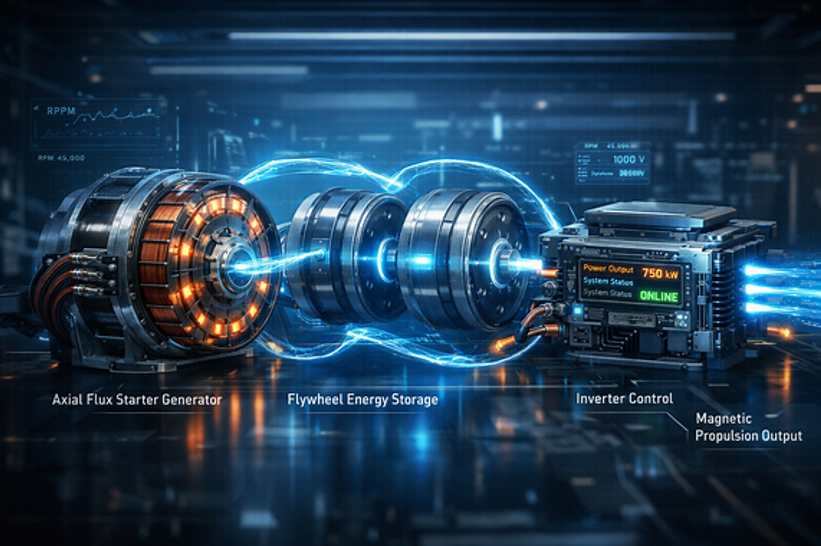
Regenerative Power Systems — The Continuity Engine of the Magnetic Ecosystem Every mobility system in history has been limited by the same constraint: energy must be carried, consumed, and replenished. Fuel runs out. Batteries deplete. Engines overheat. JRAD eliminates that constraint entirely. At the core of the Magnetic Ecosystem is the Regenerative Power Architecture — a closed‑loop system built around Axial Flux Starter Generators (AFSG), high‑density flywheel storage, and magnetic field recycling. Instead of consuming energy to create motion, JRAD captures the energy released when magnetic fields reorganize into coherence. Motion becomes regeneration. Stability becomes power. Equilibrium becomes fuel. AFSG units convert magnetic field interactions into continuous electrical potential, while flywheels store and release energy with near‑zero loss. Together, they form a power cycle that replenishes itself faster than it is consumed. This is not perpetual motion — it is perpetual coherence, a system that harvests the energy of alignment rather than fighting against it. In emergency vehicles, regenerative cycling sustains hover‑glide operations without refueling or recharging. In law enforcement units, it powers persistent patrol and field stabilization without downtime. In medical habitats, it maintains life‑support, climate control, and magnetic lift for extended deployments in remote or damaged environments. In magnetic drones, it enables indefinite flight, creating a persistent aerial network that never needs to land. Regenerative Power Systems are the reason JRAD vehicles do not rely on roads, runways, charging stations, or fuel depots. They are the reason the Magnetic Ecosystem can operate continuously, autonomously, and independently of infrastructure. They are the reason mobility becomes a field phenomenon, not a mechanical one. JRAD does not treat energy as something to be consumed. It treats energy as something to be recovered, recycled, and returned through the natural behavior of magnetic fields seeking coherence. Regenerative Power Systems are the continuity engine of the Magnetic Ecosystem — the architecture that makes magnetic mobility not just possible, but inevitable.