Using Physics to Engineer Magnetic Mobility
Building toward scalable, modular magnetic conveyance across any environment
OUR MISSION
JRAD is investigating whether magnetic conveyance can be made more reliable by pairing engineered ferromagnetic rails with active coil arrays monitored by continuous AI oversight.
Our work explores whether rotational duty cycles, intelligent redundancy, and real‑time diagnostics can meaningfully reduce wear, extend operational life, and stabilize contactless motion.
The underlying physics is validated — the coil–rail architecture closes with comfortable margin.
What remains open is prototyping: determining whether an AI‑assisted magnetic conveyance system can outperform conventional DCV reliability in real‑world operation.
JRAD’s mission is to pursue that question through disciplined modeling, controlled experimentation, and future hardware development.
MAGNETIC ALTERNATIVE
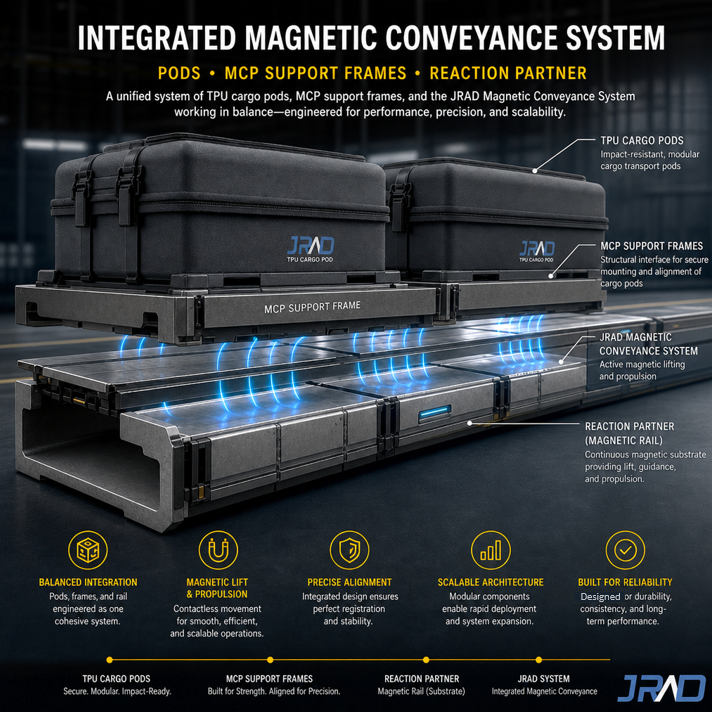
Conventional conveyance relies on wheels, bearings, and continuous mechanical contact — systems that wear down over time and require constant maintenance. JRAD is exploring a magnetic alternative built on a paired architecture: active magnetic coils interacting with ferromagnetic rails engineered as the reaction partner.
Our work investigates whether this paired system can be made more reliable through:
• rotational coil duty cycles
• intelligent redundancy
• continuous AI monitoring
• predictable field control
• reduced mechanical failure modes
This is not a replacement for existing magnetic systems like maglev. It is an inquiry into whether a more maintainable, more resilient magnetic conveyance system can be engineered by providing both the conveyance platform and the ferromagnetic rails it depends on.
THE JRAD DOCTRINE
1. Magnetic Conveyance Requires a Reaction Partner -
JRAD’s architecture is built on a paired system: active magnetic coils onboard the conveyance platform interacting with ferromagnetic rails engineered as the reaction partner. This pairing is fundamental — stable levitation, guidance, and reliability emerge from engineering both sides of the interaction: the coil array and the rail substrate. This principle anchors the entire JMCS design.
2. Reliability Through Redundancy -
JRAD investigates whether reliability can be improved through distributed magnetic control, including rotational coil duty cycles, engineered rail geometries, and multi coil field shaping. By rotating active coils, redistributing load, and designing rails for predictable magnetic response, we explore whether failure modes can be reduced and operational life extended under real industrial conditions.
3. Continuous Monitoring as an Engineering Principle -
JRAD explores whether AI driven sensing and real time diagnostics can support safer, more stable, and more maintainable magnetic conveyance. This includes monitoring magnetic field strength, coil health, and thermal load, and triggering automated interventions — such as coil swaps, thermal venting, or net coil additions — whenever operational thresholds approach breach conditions. The goal is to determine whether an intelligent monitoring layer can maintain stable levitation and guidance by correcting issues before they propagate.
4. Physics Applied -
JRAD uses established electromagnetic principles to study whether contactless conveyance can be made more reliable through controlled coil rail interactions, not through unbounded or substrate free magnetic motion.
5. Prototyping as an Open Question (AI Driven Reliability Focus) -
JRAD’s magnetic conveyance architecture is grounded in closed derivations and validated physics. The coil–rail interaction, lift margin, and propulsion requirements have all been quantified and shown to be viable with comfortable engineering margin.
What remains open is prototyping — specifically whether AI assisted reliability can deliver measurable improvement over existing DCV failure rates and downtime. This includes determining whether advanced monitoring and automated intervention can meaningfully enhance operational stability through:
• magnetic field strength monitoring
• coil failure detection
• thermal load tracking
• automated restoration triggers
• duty cycle rotation and coil swaps
• thermal venting when thresholds approach breach
• net coil additions to reinforce field strength
• predictive adjustments based on trend analysis
The physics is closed. The engineering is tractable. The question now is whether AI driven reliability can outperform conventional systems in real world operation.
JRAD’s work lives in the transition from validated architecture to proven hardware — and in testing whether intelligence can make magnetic conveyance meaningfully more dependable.